
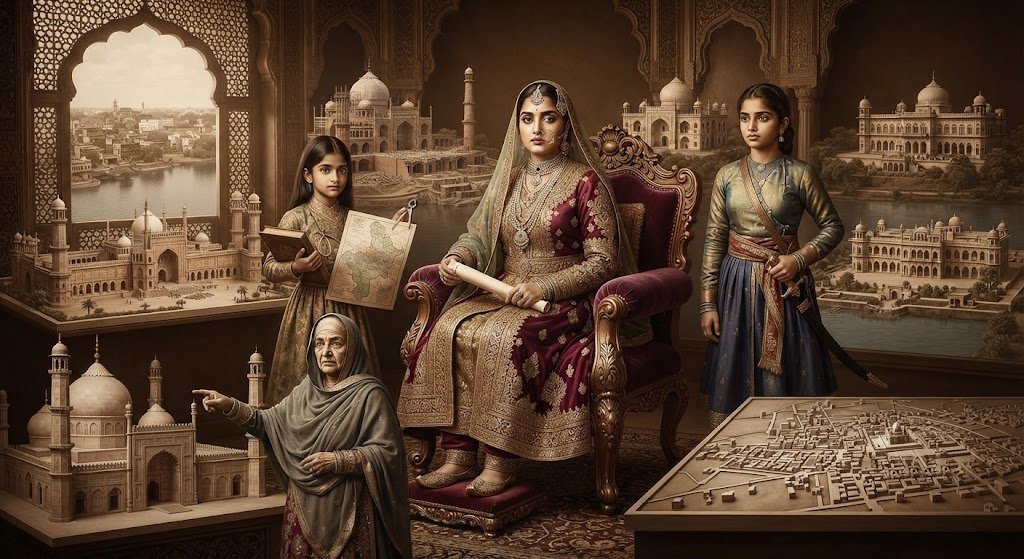
The princely state of Bhopal was ruled by four incredible women for more than a hundred years. The Begums of Bhopal reigned from 1819 to 1926, a feat that remains unmatched by any other state. The city as it stands today owes many of its monuments and historical structures to the Begums. More importantly, it is the social, civil and political fabric of the city that has been deeply influenced by their rule.
Who were the Begums of Bhopal?
The four begums of Bhopal are a succession of mothers and daughters. Qudsia Begum was the first female ruler of the princely state. She was followed by her daughter, Sikander Begum, who is credited with expanding the territory. Shah Jahan Begum, daughter of Sikander Begum, was instrumental in urban planning. Finally, Sultan Jahan Begum, daughter of Shah Jahan Begum, was the last female ruler of the princely state of Bhopal. Her contributions to education and healthcare continue to have long-lasting effects to date.
1. Qudsia Begum
Qudsia Begum came to power at the young age of 18 after the sudden death of her husband. But she was not the heir apparent after Nawab Nazar Muhammad Khan died in a freak accident. She had to convince and negotiate with the state nobles, religious heads and the British to become the Queen Regent until her daughter came of age. What Qudsia Begum managed to do was phenomenal. She not only held power, but paved the way to institutionalise the power of females to rule by legalising and culturally normalising it.
Qudsia Begum was also known for her sharp political acumen. She chose to align and engage with the British, rather than oppose them. The British, in return, acknowledged the sovereignty of Bhopal. They provided military help when neighbouring states attacked.
When Qudsia Begum came to power, the state was ridden with debt. By the time of her death in 1819, Bhopal was financially and politically stable, as well as administratively effective. She is also credited with building the Gohar Mahal Palace and Jama Masjid.
2. Sikandar Begum
With her mother by her side, Sikandar Begum trained in martial arts and politics. She hunted, was a good archer and swordswoman and played polo – things that were meant for princes to do. Her reign began in 1844 when her husband, Nawab Jahangir Muhammad Khan, died. With her military skills, she annexed several regions in Sehore, Malwa and Ichhawar and brought them under her rule. Sikandar Begam also took an interest in modernising weapons and training techniques.
Under her reign, the Moti Mahal, Moti Masjid and Shaukat Mahal were built. She also commissioned several civil and public work initiatives. Roads connecting far-away villages were constructed along with bridges and markets. The Begum also oversaw urban planning by widening roads and putting in place proper drainage systems. She also built the first exclusive schools for girls. Students were taught basic administrative, medical and craft skills. By funding scholarships for female students and encouraging adult literacy programs, Sikandar Begum laid the foundation for women’s education in Bhopal.
Though Muslim, the Begum protected temples, encouraged celebrations of all religions, and emphasised communal harmony. She passed away in 1868 and was succeeded by her daughter Shah Jahan Begum.
3. Shah Jahan Begum
Shah Jahan Begum was a connoisseur of art, music and architecture. She commissioned the iconic Taj-ul-Masajid in Bhopal. Also, she did not stop at constructing religious structures alone. She worked closely with the British in establishing railway lines that connected Bhopal to cities such as Delhi and Kolkata. The rail connectivity helped in strengthening Bhopal’s economy. Local and agricultural goods found a wider range of buyers. She continued to encourage girls’ education and also expanded it to vocational programs. Besides, she made efforts in raising legal and social awareness around widow remarriage and women’s inheritance laws.
Shah Jahan Begum wrote several books in Urdu, including the Taj-ul-Iqbal Tarikh-e-Riyasat-e-Bhopal, a historical documentation of the Bhopal dynasty. Tahzeeb-un-Niswaan wa Tarbiyat-ul-Insaan is considered a reformist work that highlighted the status, education and duties of women in society. At 62 years old, she passed away in 1901, to be succeeded by her daughter, Sultan Jahan Begum.
4. Sultan Jahan Begum
The last of the four begums, Sultan Jahan Begum was also a great champion for education. She was the first and founding Chancellor of Aligarh Muslim University. She became the first woman in India to serve as a chancellor for a university. Besides, she made primary education both mandatory and free. She also founded several new schools in the state.
Her contributions to the field of healthcare are also as significant as her contributions to education. She established the Lady Minto Nursing School and encouraged professional medical training for women, including midwives and Unani doctors. She personally looked into the workings of women’s clinics. The Begum also provided grants to various medical hospitals in the country. Besides, she implemented the use of vaccines and also held mass public vaccination campaigns. Tandrusti, her publication on healthcare, was widely read during the time. She also built Qasr-e-Sultani Palace, which is now Saifia College.
Sultan Jahan Begum voluntarily transferred her powers to her son Hamidullah Khan in 1926, marking the end of the rule of the begums.
The reign of the Begums of Bhopal has left lasting impressions on the urban, cultural and social landscape of the city. From structures to educational institutes and hospitals, the legacy of the Begums is clearly visible. However, they envisaged and led by example what women’s empowerment truly entailed. Their influence and impact were not limited to the city. But proved what women in power can do for the upliftment and development of the people.




2 Responses
Super easy navigation and the bonuses are actually attainable. I love how straightforward everything is on phplus777login. 5 stars from me!
Really love the interface and the variety of games available. It feels very smooth on mobile. Highly recommend phfh777 to everyone.